

You’ve seen the ads. Type a prompt into ChatGPT, Jasper, or Copy.ai, and within seconds, you have a 1,500-word blog post. No writer fees. No back-and-forth edits. Just instant content.
But there is a knot in your stomach. If Google detects this, will it bury your site? Will the next Helpful Content Update wipe out months of work?
Here is the truth most agencies won’t tell you: AI content can rank. But the AI-generated content that actually wins in 2025 looks nothing like the raw output you get from a chatbot.
By the end of this post, you will know exactly where AI helps, where it destroys your organic traffic, and how XCONS Solutions Ltd builds AI-assisted strategies that pass Google’s strictest tests.
What Google Actually Says About AI Content
Let us cut through the rumour mill first.
In February 2023, Google updated its Search Central guidance on AI-generated content. The official position has not changed since: It is not the production method that matters. It is the quality.
Google’s algorithms from Panda to SpamBrain to the Helpful Content Update target low-value, manipulative, or unhelpful content. If you publish an AI-generated page that is well-researched, original, and genuinely useful to a searcher, Google has no technical penalty for that.
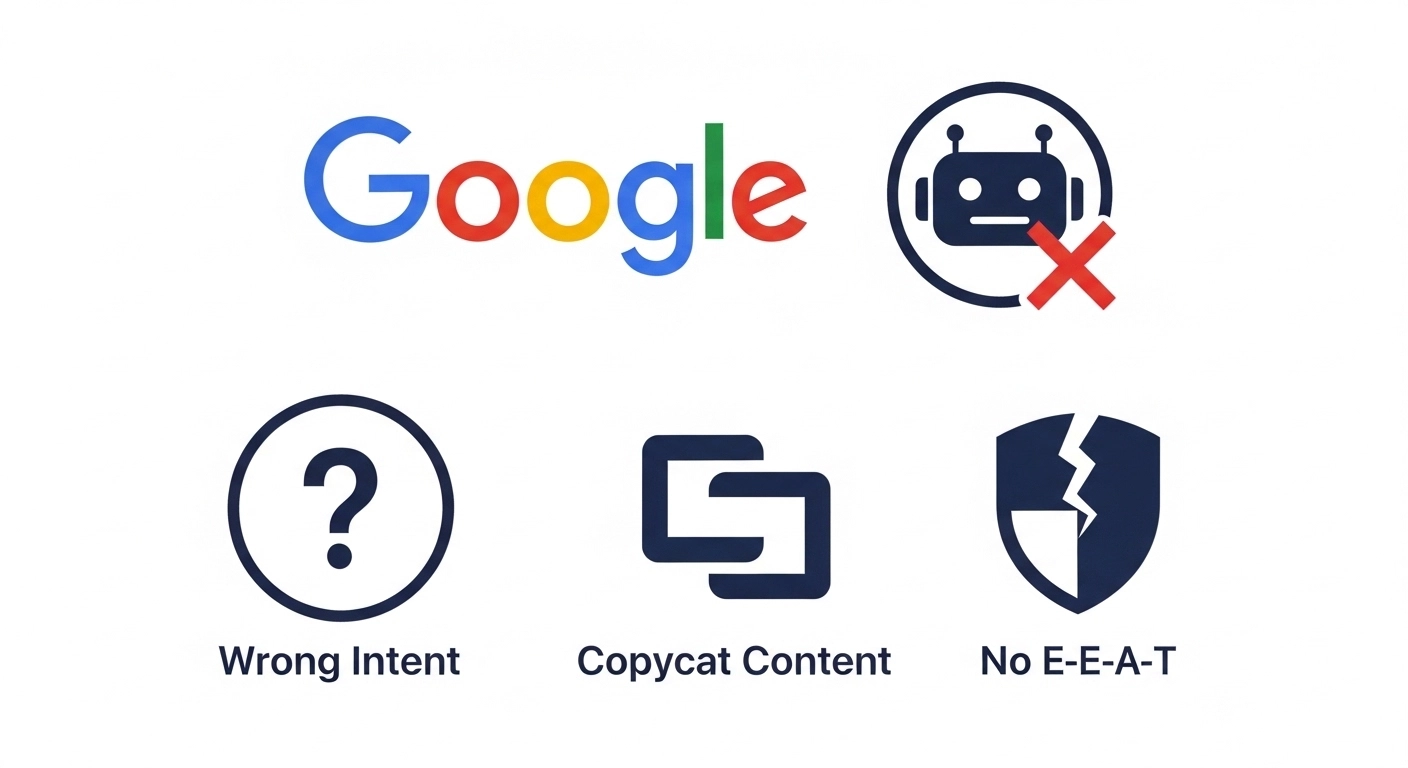
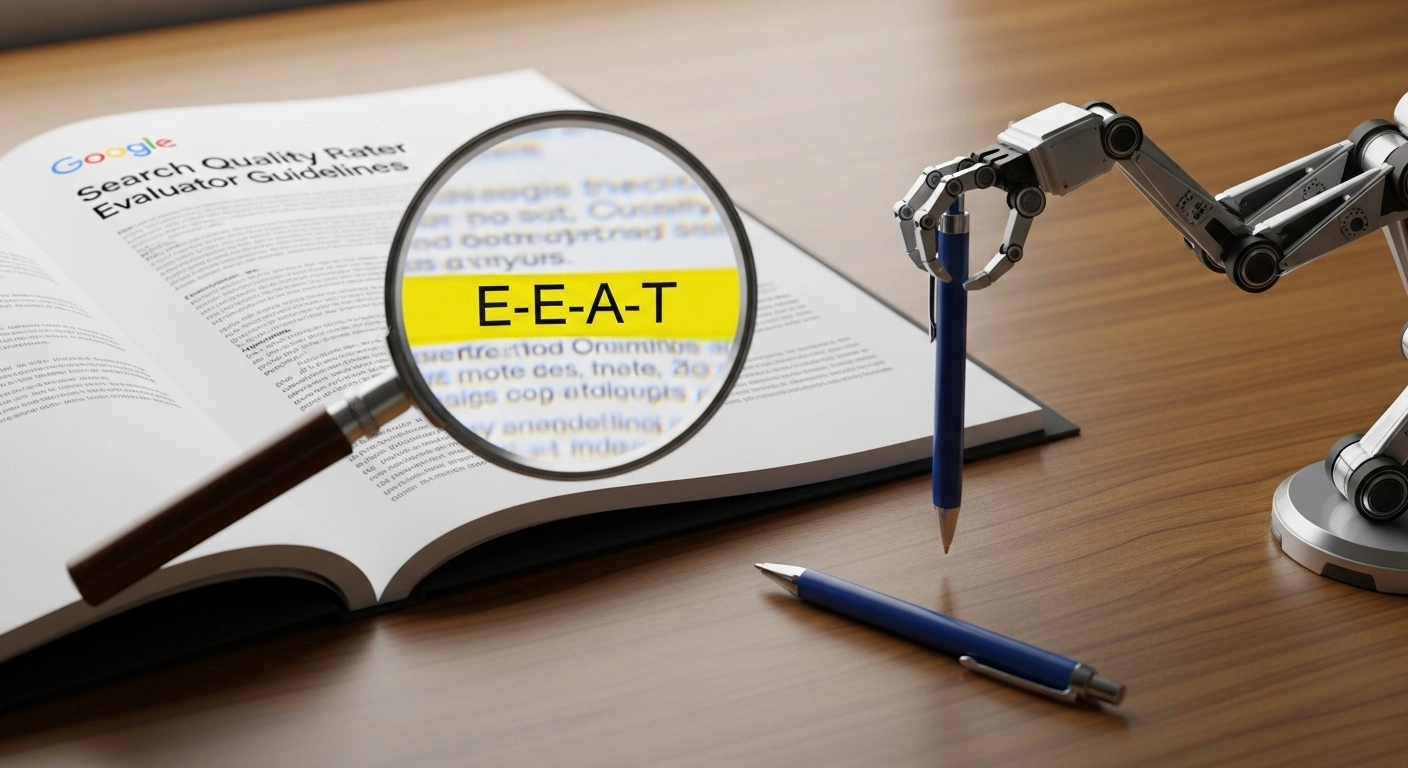
But here is where UK business owners get caught out. Google’s Search Quality Rater Guidelines are built on E-E-A-T: Experience, Expertise, Authoritativeness, and Trustworthiness. AI tools have none of these. They do not test products. They do not visit your Manchester warehouse. They have never used your SaaS platform.
So while Google does not ban AI content, its algorithms are now exceptionally good at detecting content that lacks real-world experience. Thin, generic, or factually questionable AI content gets demoted or deindexed entirely.
The takeaway: Google rewards helpfulness, not humanity. But AI alone rarely produces genuinely helpful content.
At XCONS, we combine AI efficiency with human SEO expertise to create content that satisfies both Google and real readers. See how our SEO content writing works.
When AI Content Does Rank Well (And Why)
We are not anti-AI. That would be dishonest. Used correctly, large language models are a force multiplier for SEO.
Here is when AI-generated content genuinely ranks.
Factual, Structured Content
Comparison tables, technical specifications, glossary definitions, and FAQ schemas. AI excels at reformatting known information into scannable, useful blocks. A London ecommerce store selling electronics used AI to generate 40 product comparison tables each reviewed and corrected by a human editor and saw featured snippet wins within six weeks.
Content Heavily Edited by an SEO Specialist
This is the biggest success category. An SEO expert uses AI for a rough first draft, then rewrites intros, adds original data, inserts local references (Ilford, Bristol, Leeds), adjusts for search intent, and builds internal links. The final result is 70% human, 30% AI. That content ranks consistently.
Research, Outlining and Drafting — Not Publishing
Smart marketing teams use AI to cluster keywords, generate 20 headline options, or produce five counter-arguments to address in a post. The AI never touches the live site. But it makes the human writer twice as fast.
High-Volume, Lower-Competition Informational Keywords
For “how to clean a coffee machine” or “average office desk height cm”, AI-generated content that is accurate and well-formatted can rank without heavy editing. The risk is low because the competition is either zero or massive authority sites.
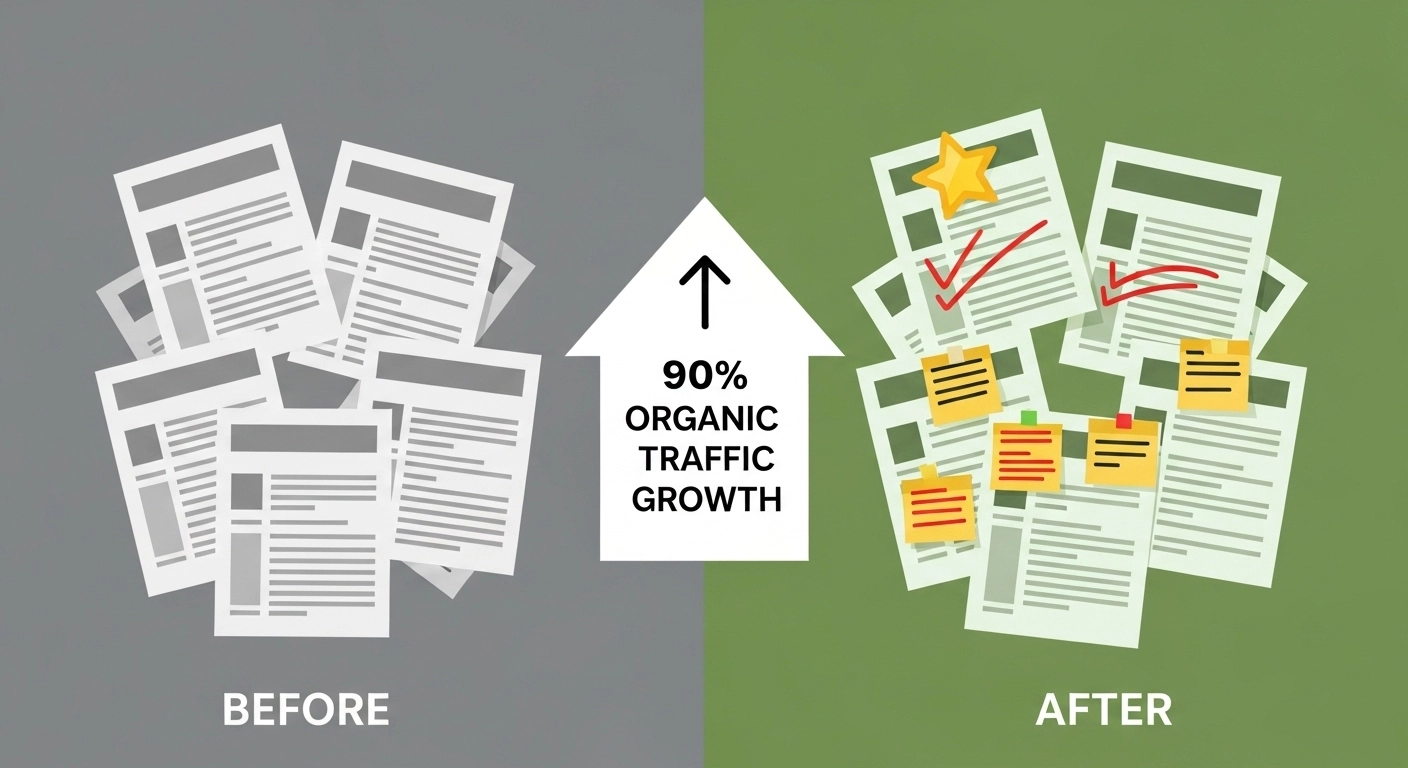
Real-world example: A Birmingham-based SaaS startup used AI drafts reviewed by a senior SEO editor to publish 40 blog posts in three months. Organic traffic grew 90% in six months. The differentiator was never the tool. It was human oversight, search intent alignment, and genuine value-add.
When AI Content Fails — And Tanks Your Rankings
Now the warning. We have audited sites across Birmingham, Leeds, and London where AI content floods quietly destroyed organic visibility over six to twelve months. Business owners saw blog traffic spike initially, then crater. Here is why.
Generic, Thin Content With No Original Insight
AI generates plausible, not truthful. Ask ChatGPT “what are the best project management tools for UK construction firms” and you will get a bland list of Trello, Asana, and Monday.com—no mention of UK-specific compliance, no real user experience. That content will not earn backlinks, shares, or long dwell time. Google notices.
Wrong Search Intent
This is a silent killer. AI writes what sounds like a good answer, not what the searcher actually needs. A transactional keyword like “buy WordPress maintenance plan London” gets an informational blog post about “what is WordPress maintenance”. The bounce rate hits 90%. Rankings collapse.
No E-E-A-T Signals
No author byline. No publication date. No linked LinkedIn profile. No case studies. No original photography. No client testimonials. Google sees a page with zero indicators of real-world experience and assumes it is low-value mass production.
Keyword Stuffing Disguised as Fluency
AI is so fluent that some marketers trick themselves. They prompt “write 2,000 words about SEO services UK” and the AI naturally repeats “SEO services UK” 47 times. That is still keyword stuffing. Google’s SpamBrain detects it instantly.
Duplicate or Near-Duplicate Content
Run the same prompt twice on different AI tools. The outputs will be structurally identical but paraphrased. Google’s algorithms are exceptionally good at near-duplicate detection. Your five “benefits of Shopify SEO” blog posts will cannibalise each other and all fail to rank.
Factual Errors That Damage Trust
AI hallucinates. We have seen AI-generated content claim that Glasgow is in England, that VAT registration is optional for UK ecommerce, and that Google Ads has no daily budget minimum. Those errors destroy brand credibility and guarantee zero quality backlinks.
Worried your content strategy might be doing more harm than good? Get a free SEO content audit from XCONS
The Smart Approach — AI-Assisted, Human-Led Content Strategy
The businesses winning in search right now are not “AI-first” or “human-only”. They are strategy-led. Here is the exact framework we use at XCONS Solutions for WordPress SEO, Shopify SEO, and lead generation content across the UK.
Step 1: Keyword and intent research (human-led)
We analyse search volume, difficulty, SERP features, and—crucially—search intent using Semrush, Ahrefs, and Google Search Console. No AI tool does this reliably yet.
Step 2: Content brief creation (human-led, AI-assisted for clustering)
Our SEO specialists write detailed briefs: target audience, questions to answer, internal linking targets, related keywords, and E-E-A-T requirements. We use AI to suggest topic clusters, but the strategy is human.
Step 3: AI draft generation (AI tool)
We use ChatGPT, Claude, or Gemini to produce a first draft. This is the fastest step and the least valuable one. The draft always needs work.
Step 4: Expert editing for accuracy, tone, E-E-A-T, and originality (human-led)
This is where rankings are won. Our editors add original examples, UK-specific data, client case studies, author credentials, and genuine insight. They remove AI hallucinations and fluff. They optimise for readability and dwell time.
Step 5: On-page SEO optimisation (human-led)
Title tags, meta descriptions, URL slugs, header hierarchy, internal links, image alt text, and schema markup. We use Yoast SEO on WordPress and similar tools on Shopify, but the decisions are human.
Step 6: Publishing, indexing, and performance tracking (human-led)
We submit to Google Search Console, monitor Core Web Vitals, track rankings in GA4, and iterate based on data. Content is never “set and forget”.
We do not just write content. We build content strategies that compound over time. Whether you need blog writing services for a startup or a full ecommerce content engine on Shopify, this framework delivers rankings without risk.
Ready for a content strategy that actually ranks? Talk to XCONS Solutions today.
What This Means for Your UK Business in 2026?
The competitive landscape in the UK is brutal. Every ecommerce store in Manchester, every agency in Edinburgh, every B2B startup in Sheffield is publishing content. The barrier to entry has never been lower—thanks to AI—which means the differentiators have never been more important.
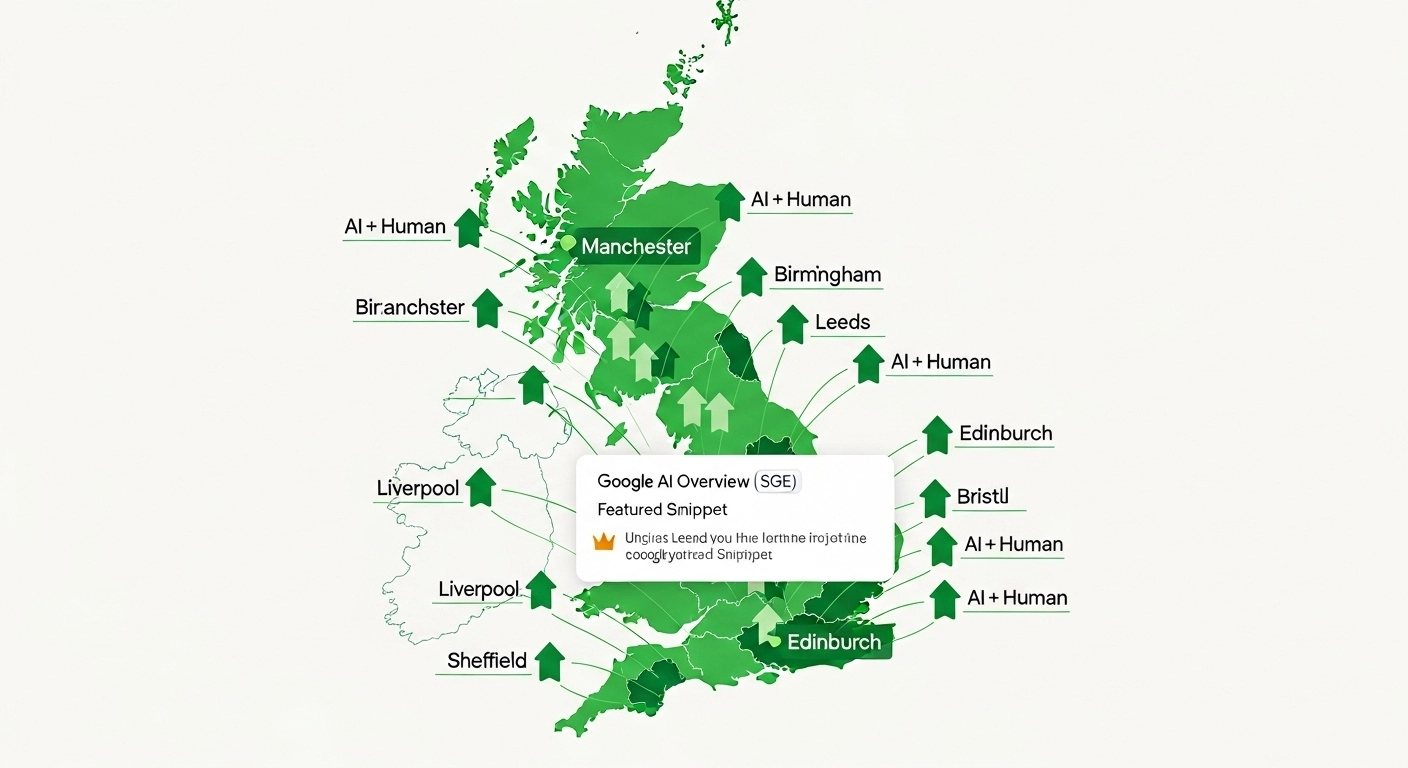
Here is what is changing fast. Google’s AI Overviews (formerly SGE) are reshaping what “ranking” even means. For many informational queries, the answer now appears above the organic results, pulled from high-E-E-A-T sources. If your content is generic AI slush, you will not be cited. If your content is authoritative, original, and trusted, you get the AI Overview citation and the top organic position.
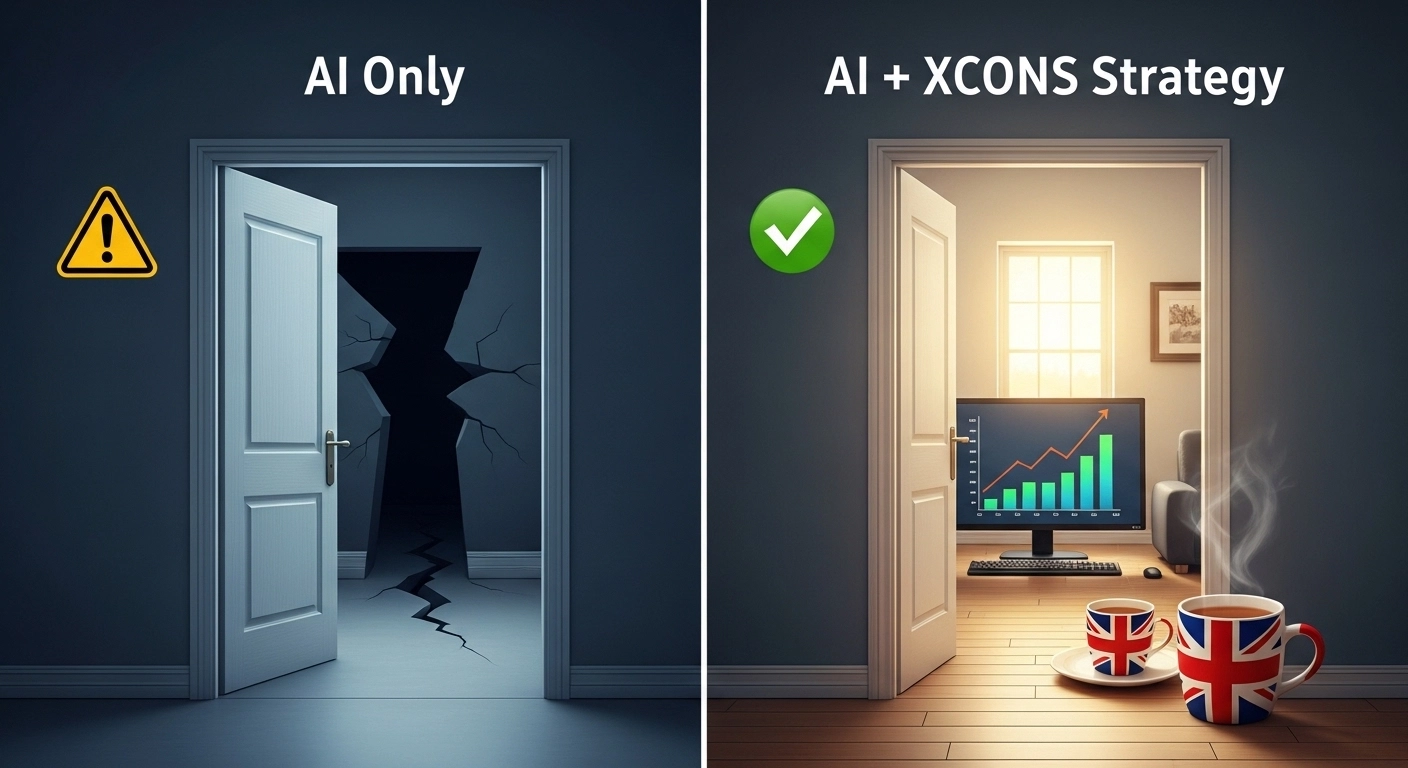
Businesses that combine AI efficiency with genuine SEO expertise will outpace those going fully manual (too slow, too expensive) or fully AI (low quality, high risk). There is no third option.
XCONS stays ahead of every algorithm update. We monitor Google’s documentation, test against real client sites across the UK, and adjust our frameworks quarterly. When the Helpful Content Update rolls out another wave, our clients’ traffic does not dip—it often grows, because we were never publishing low-value content to begin with.
From Shopify stores in Sheffield to WordPress agencies in Glasgow, the businesses winning in search right now have one thing in common: a strategy, not just a tool.
Frequently Asked Questions
Will Google penalise my website for using AI-generated content?
No, Google does not automatically penalise AI content. The company’s official guidance states that “appropriate use of AI or automation is not against our guidelines.” However, Google does penalise low-quality, unhelpful, or manipulative content regardless of how it was produced. If your AI content lacks original insight, factual accuracy, or real-world experience (E-E-A-T), it will likely be demoted or deindexed. The safest approach is AI-assisted, human-led content production—exactly what XCONS delivers for UK businesses.
What is E-E-A-T and why does it matter for AI content?
E-E-A-T stands for Experience, Expertise, Authoritativeness, and Trustworthiness. It is the framework Google’s human quality raters use to evaluate content quality. AI tools have none of these qualities—they do not have lived experience, professional credentials, or established authority. This is why raw AI content rarely ranks well. To succeed, you must add human E-E-A-T signals: author bylines, client case studies, original data, professional credentials, and genuine user experience. XCONS builds E-E-A-T into every piece of content we produce for clients across the UK.
How do I use AI content tools without hurting my SEO rankings?
Use AI for research, outlining, drafting, and content clustering—never for final publishing without human editing. Every piece of AI-generated content must be reviewed by an SEO specialist who checks factual accuracy, search intent alignment, on-page optimisation, and E-E-A-T signals. Add original examples, UK-specific details, and internal links to authoritative pages on your site. Finally, monitor performance in Google Search Console. If pages see high impressions but low clicks or high bounce rates, that AI content needs reworking. For a complete, risk-free AI content strategy, XCONS offers full-service SEO and content production.