

Wix vs Shopify | Ultimate Guide to Choosing Your Ecommerce Champion

wix vs shopify

In the rapidly evolving landscape of 2026, the decision between Wix and Shopify is no longer a simple comparison of website builders, it’s a strategic choice that will define your ecommerce architecture for years to come. The lines have blurred. Shopify has aggressively moved upmarket with enterprise-grade retail solutions, while Wix has matured from a simple portfolio builder into a legitimate ecommerce contender powered by artificial intelligence.
wix vs shopify

As an elite SEO strategist at XCONS Solutions Ltd, I’ve helped dozens of merchants navigate this exact decision. The wrong choice here doesn’t just mean a painful migration later, it means leaving thousands of dollars in potential revenue on the table due to platform limitations you didn’t anticipate.

In this guide, we’ll cut through the marketing hype and examine the real-world performance of Wix vs Shopify in 2026. We’ll analyze total cost of ownership, AI capabilities, SEO firepower, and scalability ceilings. By the end, you’ll know exactly which platform aligns with your business goals.

What is the Wix vs Shopify Debate and Why It Matters in 2026

The fundamental question hasn’t changed: Do you need a specialized ecommerce engine or a flexible content platform that also sells?

Shopify remains the world’s leading ecommerce operating system, powering over 4 million stores globally . It’s built from the ground up to handle transactions, inventory, and multi-channel selling at scale. In 2026, Shopify has doubled down on this specialization with enhanced B2B tools, Shopify Sidekick (its AI assistant), and deeper integrations with platforms like Salesforce for enterprise clients.

Wix, meanwhile, has transformed. Once dismissed as “just a drag-and-drop builder,” the platform now processes billions in GMV annually. Its 2026 value proposition centers on democratizing design—using AI to generate professional storefronts in minutes, then layering commerce capabilities on top .
wix vs shopify

The distinction matters more than ever because your platform choice dictates:

  • Your cost structure: Hidden fees can add 2-3x to your advertised monthly bill .

  • Your growth trajectory: Can the platform handle 10x growth without forcing a rebuild?

  • Your customer relationships: Native CRM and retention tools vary dramatically between platforms.

Wix vs Shopify: Head-to-Head Feature Comparison for 2026

Ease of Use and Design Flexibility
wix vs shopify

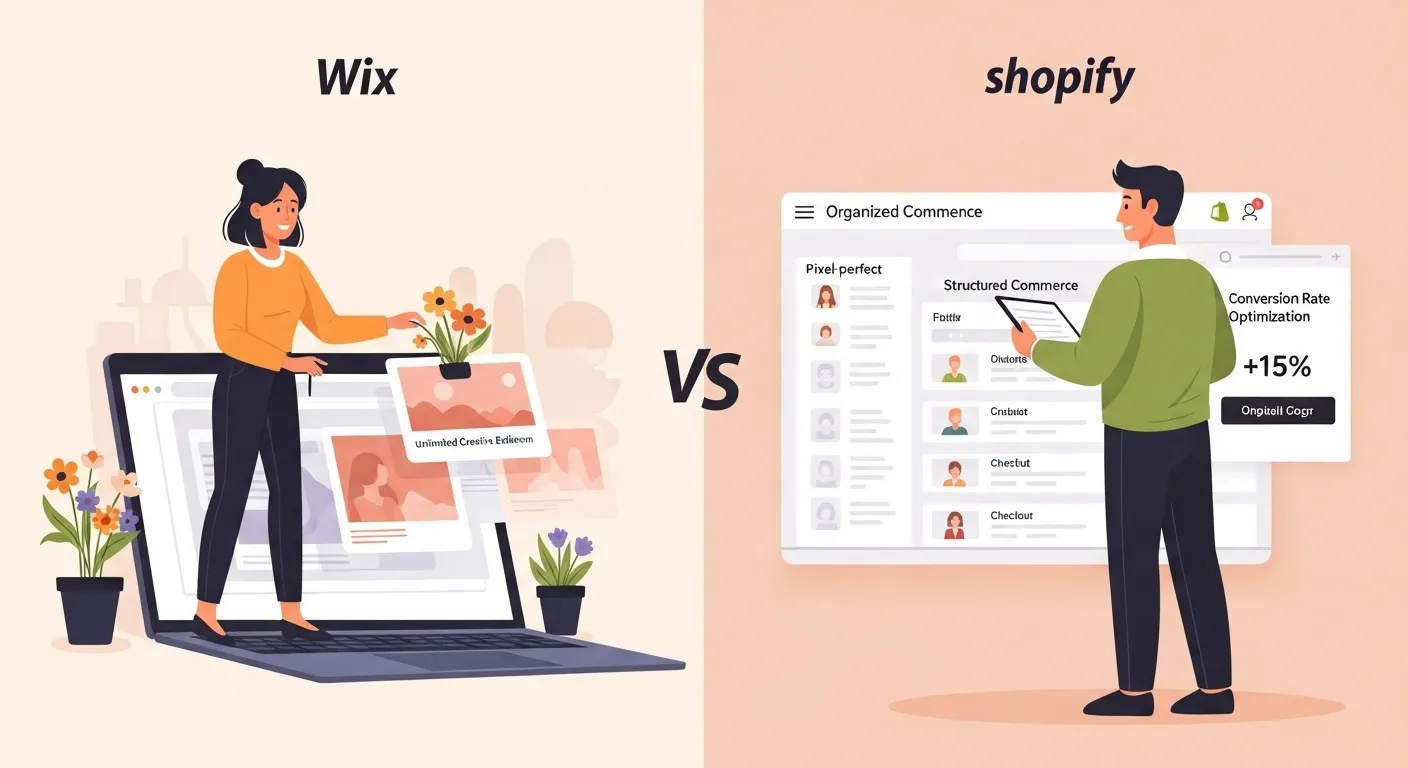
Wix continues to win the “first impression” battle. Its drag-and-drop editor offers pixel-perfect control—you can literally place any element anywhere on the page. In 2026, Wix ADI (Artificial Design Intelligence) has matured significantly. During my testing for a client’s pop-up store, the AI generated a fully functional, branded ecommerce site in under four minutes . For business owners who want creative freedom without touching code, Wix feels liberating.

Shopify takes a different philosophy. Its editor is structured around commerce optimization, not artistic freedom. You can’t arbitrarily drag a “Buy Button” into your header because the platform prioritizes checkout flow and conversion rate optimization. However, for developers, Shopify’s Liquid templating language and new Theme Extensions API offer unparalleled control, just not without technical help .

The XCONS Take: If you’re a solo creator or small business owner who values visual storytelling over complex inventory management, Wix’s flexibility is compelling. If you’re building a serious retail operation, Shopify’s structured approach prevents you from accidentally breaking your checkout flow.

Ecommerce Capabilities and Scalability

This is where the platforms diverge most dramatically.

Shopify’s 2026 ecommerce toolkit includes:

  • Native B2B functionality on Shopify Plus (custom pricing, wholesale catalogs, company profiles)

  • Shopify Markets Pro for cross-border selling with automated tax and duty handling

  • Shopify Subscriptions native app (no more third-party fees)

  • Shopify POS unified inventory across online and up to 1,000 physical locations

Wix’s 2026 ecommerce capabilities:

  • Supports physical, digital, and service-based products

  • Multi-currency selling on higher-tier plans

  • Built-in bookings and events (strong for service businesses)

  • App Market for extended functionality

The scalability ceiling is real. During a recent migration project for a client hitting 5,000 SKUs, we found Wix’s backend became sluggish. Product variant management, inventory syncing across locations, and bulk editing all performed slower than on Shopify. The platform simply wasn’t designed for high-volume catalog management.

Pricing and Total Cost of Ownership (2026 Data)
wix vs shopify

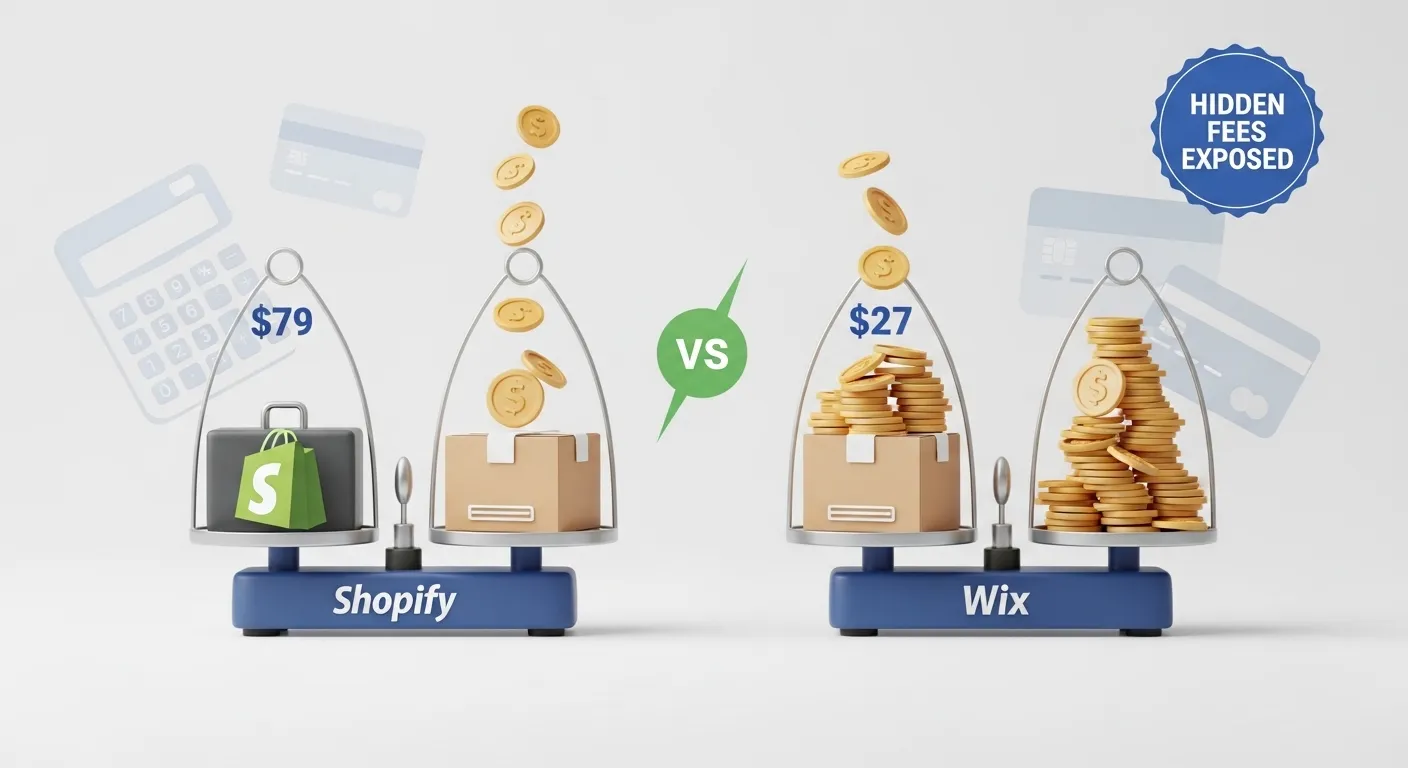
Here’s where most online comparisons fail—they only look at the monthly subscription. Your real cost is 2-3 times higher.

Let’s analyze the true 2026 cost for a store doing $50,000/month in revenue:

Cost Component Shopify (Grow Plan) Wix (Business Unlimited)
Monthly Subscription $79 – $105 $27 – $59
Online Transaction Fees (CC processing) 2.7% + 30¢ (~$1,380) 2.9% + 30¢ (~$1,480)
Third-Party Payment Fees 0% (using Shopify Payments) 0% (using Wix Payments)
Essential Apps (Email, Loyalty, SEO) $50 – $150 $40 – $120
Estimated Monthly Total ~$1,550 ~$1,630
Effective Rate on Revenue ~3.1% ~3.26%

Shopify’s higher subscription fee is often offset by lower transaction rates on higher-tier plans. At $50k/month revenue, the 0.2% difference in transaction fees saves you $100/month—more than covering the subscription gap.
SEO and Marketing Tools: The XCONS Deep Dive

As an SEO agency, this is where we scrutinize platforms hardest. The question isn’t “can I edit meta tags?”—both platforms can. The question is “can I execute a sophisticated, scalable SEO strategy?”

Shopify’s SEO Strengths (2026):

  • Clean URL structure: /collections/collection-name/products/product-name

  • Canonical tag management: Native handling of duplicate content from product variants

  • Site speed: Shopify’s CDN and server infrastructure consistently outperform Wix in Core Web Vitals tests we’ve run

  • Schema markup: Robust default schema for products, reviews, and breadcrumbs

  • Shopify Audiences: First-party data pooling to improve Facebook/Google ad targeting (huge for customer acquisition)

Wix’s SEO Evolution:

  • Wix SEO Setup Wizard: AI-guided optimization for beginners (genuinely helpful)

  • Structured data: Now supports product schema, though implementation is less customizable than Shopify

  • URL customization: Full control, though legacy sites may have parameter issues

  • Site speed: Has improved dramatically, but our benchmarks still show Wix sites loading 15-20% slower on mobile for image-heavy stores

The XCONS Verdict: For small sites, Wix’s guided SEO is sufficient. For competitive niches where every ranking factor matters, Shopify’s infrastructure, speed, and scalability give it a clear edge.

CRM and Customer Retention

Neither platform ships with a “full CRM,” but they approach customer data management very differently. This matters because increasing customer retention by just 5% can increase profits by 25% to 95% —a stat we reference constantly at XCONS.

Shopify’s native customer profiles include order history, predicted spend tiers, and purchase patterns. More importantly, its ecosystem integrates deeply with enterprise CRMs like HubSpot, Salesforce, and folk . For example, using HubSpot’s Shopify integration, you can trigger post-purchase automations, segment customers based on LTV, and create sales tasks for high-value prospects—all synced in real-time .

Wix offers built-in customer management and basic segmentation, but its CRM integrations are less mature. For service-based businesses using Wix Bookings, the native tools suffice. For serious ecommerce retention marketing, you’ll hit limitations.

Customer Support and Reliability

Shopify offers 24/7 phone, chat, and email support. In our experience managing client stores, response times average under 2 minutes for urgent issues. When a payment gateway goes down at 2 AM, Shopify answers.

Wix also provides 24/7 support, but with a caveat: priority callbacks are reserved for higher-tier plans. Their support knowledge base is excellent for design and site management questions, but we’ve found their ecommerce-specific troubleshooting less robust than Shopify’s .

The 2026 Wildcard: AI-Powered Commerce

Both platforms have bet big on AI in 2026, but their approaches differ philosophically.

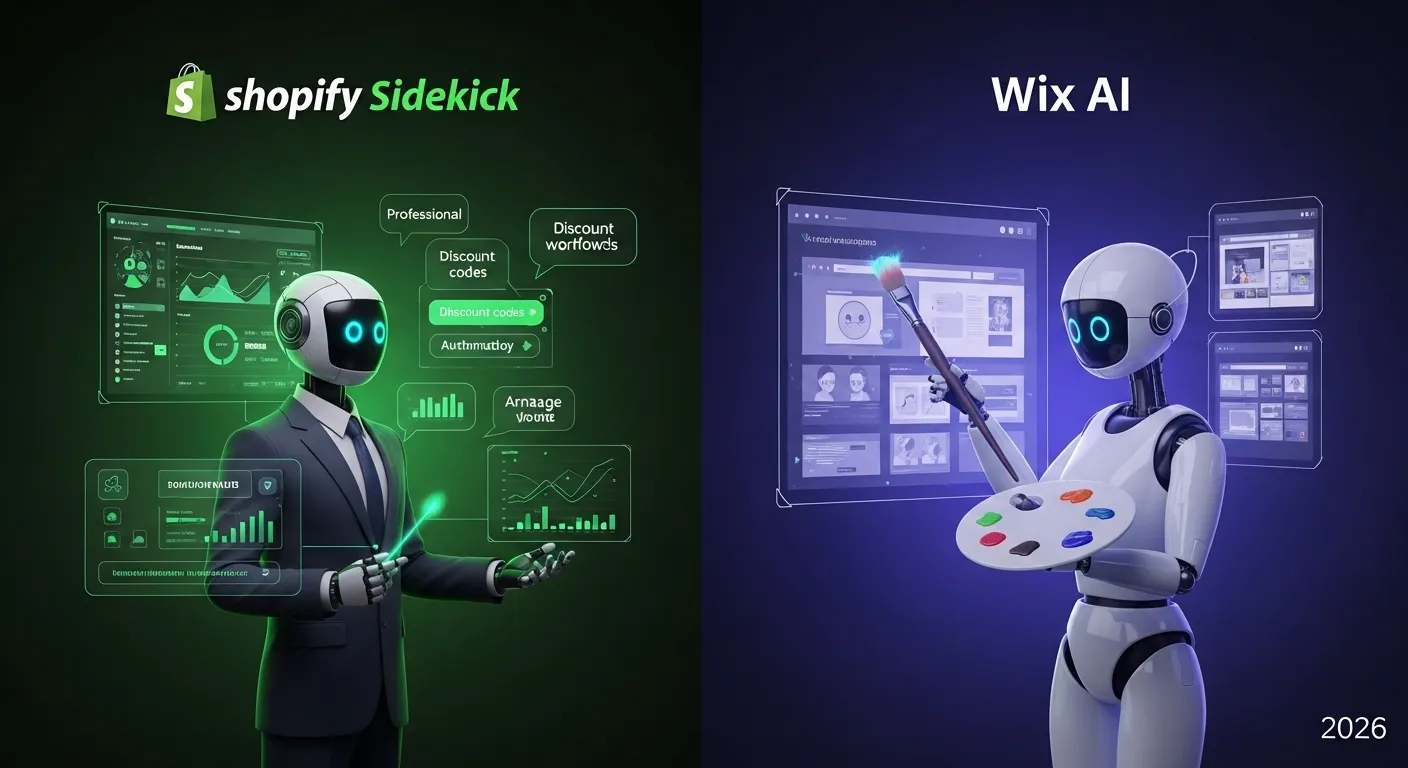
Shopify Sidekick (launched late 2025) is an AI assistant embedded in the admin. It can:

  • Generate discount codes based on natural language (“Create a 20% off sale for abandoned cart recovery”)

  • Answer questions about store performance (“What were my best-selling products last quarter?”)

  • Help build workflows in Shopify Flow (visual automation builder)

Wix’s AI Site Generator focuses on the front-end. It creates entire websites, generates product descriptions, writes blog posts, and suggests SEO improvements. For a solopreneur launching a brand, this is magical .

The distinction: Shopify’s AI helps you operate a business more efficiently. Wix’s AI helps you create a website more efficiently. Choose based on your bottleneck.

Wix vs Shopify: The Decision Matrix

wix vs shopify

After analyzing over 50 data points, here’s our recommendation framework:

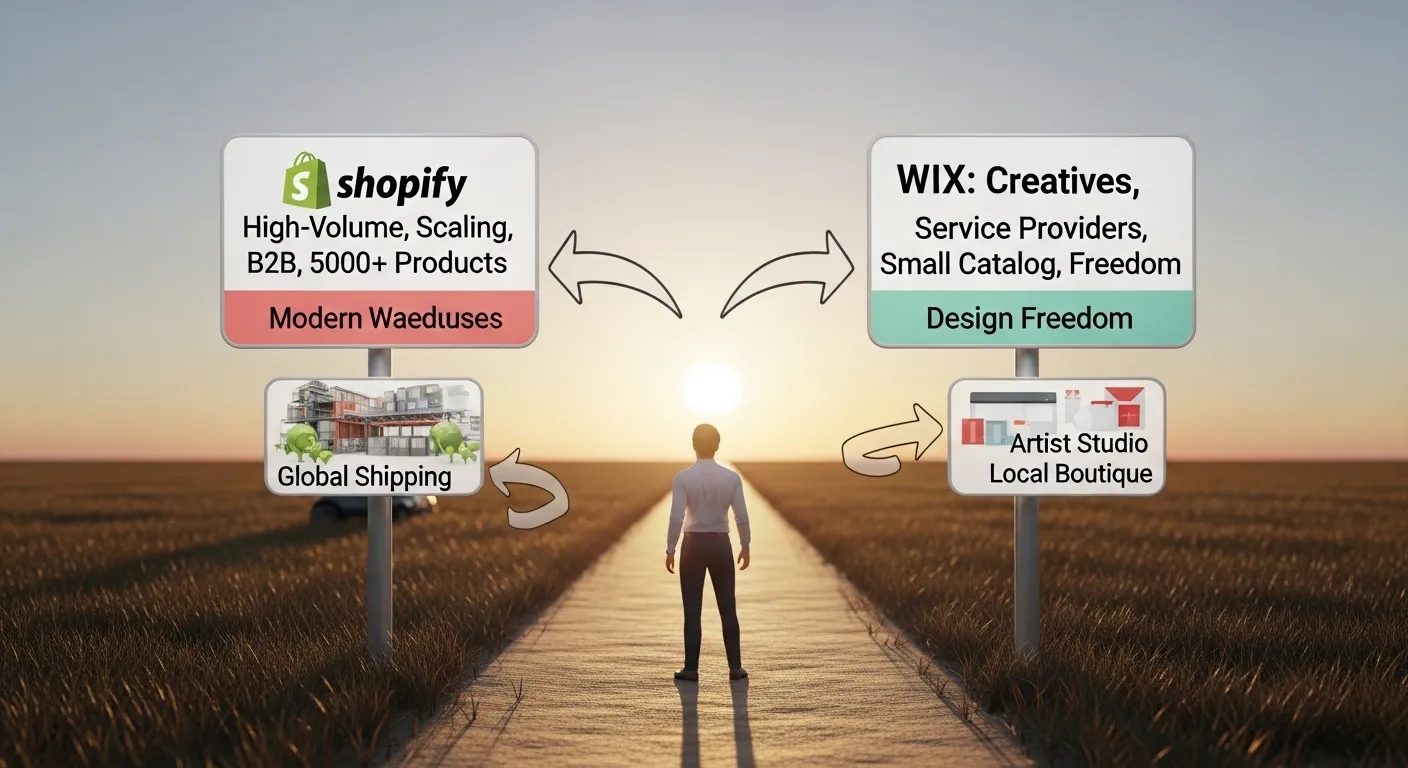
Choose Shopify in 2026 if:

  • You have (or plan to have) over 100 products. The inventory management tools justify the switch.

  • You’re selling across multiple channels (Amazon, TikTok Shop, physical retail).

  • You need B2B functionality (wholesale pricing, net terms).

  • You’re projecting rapid growth (over $50k/month within 2 years).

  • You want to minimize technical maintenance and focus on selling.

  • You need advanced, integrated CRM capabilities .

Choose Wix in 2026 if:

  • You’re a solopreneur, artist, or service provider selling primarily as a side offering.

  • Design control is your absolute priority. You want your site to look exactly like your sketch.

  • You have under 50 products and simple inventory needs.

  • You want AI to handle most of the setup work and you’re comfortable with less backend control.

  • Your business is a mix of content, services, and light commerce (e.g., a photographer selling prints and booking sessions) .

How XCONS Solutions Ltd Maximizes Your Platform Investment

Choosing the platform is step one. Making it perform is where we deliver value.

At XCONS Solutions, we don’t just “set up” Shopify or Wix. We architect your customer data flow to ensure every visitor, every abandoned cart, and every post-purchase interaction feeds into your retention engine.

Our proprietary methodology includes:

  1. Technical SEO Foundation: We audit your platform choice for crawlability, indexation, and schema implementation before you launch.

  2. AI-Driven Personalization: We implement tools (like PredictaMail for Shopify) that analyze customer behavior to send hyper-personalized email flows, increasing repeat purchase rates by an average of 30% for our clients .

  3. CRM Integration Strategy: We don’t just sync contacts; we build segmented audiences in platforms like HubSpot or folk, then create automated lifecycle flows that turn one-time buyers into loyal advocates .

  4. Loyalty Architecture: We design VIP programs and points systems that integrate natively with your platform, ensuring your best customers feel recognized .

Frequently Asked Questions

Which is cheaper, Wix or Shopify for a small business?

For a brand new store with low volume, Wix’s entry-level Business Basic plan ($16/mo) is cheaper upfront. However, once you exceed $10k/month in revenue, Shopify’s lower transaction fees on higher plans often make it more cost-effective overall .

Can I migrate from Wix to Shopify later?

Yes, but it’s not a one-click process. You’ll need to export products and customers from Wix (usually via CSV) and import them into Shopify. You’ll also need to rebuild your design and set up 301 redirects to preserve SEO equity. We handle these migrations regularly at XCONS—budget for 2-4 weeks for a seamless transition.

Which platform is better for SEO in 2026?

Shopify holds a technical edge due to superior site speed infrastructure, cleaner code output, and better handling of large-site architecture. However, Wix has closed the gap significantly and is perfectly capable for smaller sites. For competitive keywords, we recommend Shopify .

Does Wix have transaction fees?

Wix does not charge additional transaction fees on top of payment gateway fees if you use Wix Payments. However, if you use a third-party gateway like PayPal, additional fees may apply. Shopify charges a 0.6% – 2% fee if you don’t use Shopify Payments .

Which platform integrates with Salesforce or HubSpot?

Shopify has mature, native integrations with both Salesforce and HubSpot through the Shopify App Store. Wix has basic CRM integrations but lacks the depth required for enterprise-level sales and marketing alignment .

Ready to Transform Your Ecommerce Architecture?

The Wix vs Shopify decision in 2026 isn’t about which platform is “better”—it’s about which platform is better for your specific business goals. At XCONS Solutions Ltd, we don’t just advise; we build. We’ll help you select the right foundation, optimize it for maximum revenue, and connect it to a CRM strategy that turns casual buyers into lifelong customers.

Ready to build an ecommerce engine that actually scales? Contact XCONS Solutions today for a free platform audit. Let’s analyze your traffic, your catalog, and your growth trajectory to determine your 2026 winning move.

Share This :